




Voucher & Rental Assistance Programs Overview
This page provides information about the locally and federally funded voucher and rental assistance programs that are administered by the DC Housing Authority (DCHA).
Overview
The DC Housing Authority’s (DCHA) Housing Choice Voucher Program (HCVP) Department administers voucher and rental assistance programs that serve extremely low- through moderate-income individuals and families throughout the District of Columbia.
The HCVP Department administers both locally funded and federally funded programs. The most prominent programs are the locally funded Local Rent Supplement Program (LRSP) and the federally funded Housing Choice Voucher Program (HCV Program or HCVP).
All programs are administered in accordance with applicable U.S. Department of Housing and Urban Development (HUD) regulations and DC law.
If you are a current program participant, find your voucher or rental assistance type in RentCafe’s My Voucher section.
For RentCafe help, visit the Resources page.
If you are a current participant, learn more about how to use your voucher including your housing search and the lease up process.
Voucher Participant, DCHA & Landlord
As a participant in a voucher program, you are an important part of a three-way partnership designed to help you. The partnership includes DCHA as the program administrator and the landlord or owner of your unit as the lease administrator.
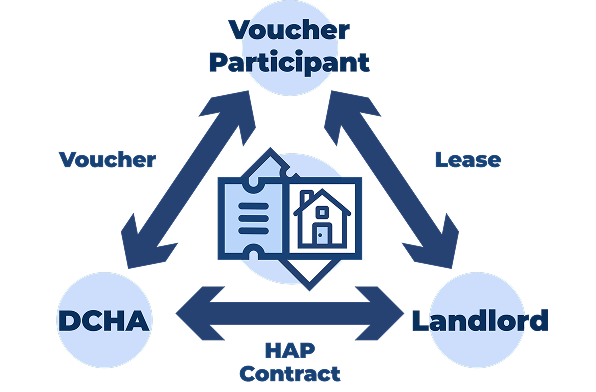
Voucher Participant
As part of the DCHA program, the voucher participant’s responsibilities include:
- providing correct information;
- finding a place to live;
- following the DCHA rules;
- paying their portion of the rent on time;
- allow DCHA staff to perform inspections; and
- being a good tenant.
Being a good tenant means following the terms of the lease, including keeping the home in good condition and paying any utilities that the tenant is responsible for on time. Other common lease terms include guidelines on guests and visitors in the home, and whether pets are allowed or prohibited.
DCHA
DCHA is the program administrator.
DCHA is responsible for confirming the family’s eligibility for the voucher program. After the voucher family identifies a unit, DCHA is responsible for:
- ensuring the contract rent is reasonable compared with the market by performing a rent reasonableness test;
- ensuring the contract rent is affordable based on the household income and household composition; and
- inspecting the unit to ensure it meets HUD’s standards.
Once the unit passes inspection and the lease has been signed, DCHA completes the Housing Assistance Payment (HAP) contract with the landlord. After the HAP contract is signed, DCHA pays its portion of the rent (HAP) directly to the landlord on a monthly basis.
Landlord
The landlord, or the owner of the unit, is responsible for providing a safe and sanitary place to live. The landlord has two separate agreements related to the assisted tenancy:
- the HAP contract is strictly between the landlord and DCHA, and it is executed on behalf of the tenant. As part of the contract, the landlord agrees to meet all voucher program standards and DCHA agrees to send its portion of the rent (HAP) directly to the landlord.
- the lease agreement is strictly between the landlord and the tenant. It outlines the rental agreement and the terms of occupancy between the landlord and tenant.
The landlord is responsible for fulfilling all obligations under both agreements, including maintaining the unit in safe and sanitary condition.
Separate from DCHA, landlords may screen prospective tenants and choose renters who they believe will make good tenants.
Some landlords hire property managers to handle the day-to-day responsibilities at the property, like screening prospective tenants, collecting rent, managing maintenance and repairs, and enforcing lease terms.
Federally Funded Programs
Federally Funded Programs
Housing Choice Voucher Program (HCVP)
The Housing Choice Voucher Program, formerly known as Section 8, is a federally funded rental assistance program that helps eligible low-income families and individuals afford housing in the private rental market. It was formally known as Section 8. In the District of Columbia, HCVP is administered by DCHA.
HCVP participants can choose any rental unit that is located within DC and meets program requirements.
An HCVP participant and the landlord enter into a lease agreement. DCHA enters into a Housing Assistance Payment (HAP) contract with the landlord.
HCVP participants may be responsible for a portion of their unit’s rent based on their household income and composition. That rent amount would be paid by the participant directly to the landlord. DCHA sends HAP directly to the landlord on behalf of the HCVP participant.
HCVP assistance includes:
Tenant-Based Vouchers
Tenant-Based Vouchers are tied to the eligible household. Individuals and families independently select their unit after receiving their voucher.
How Participants are Selected
- Pulled from HCVP Waitlist
- By Referral
Project-Based Vouchers
Project-Based Vouchers (PBVs) are tied to the specific unit. Households may need to meet additional eligibility requirements to access this assistance.
How Participants are Selected
- Pulled from HCVP Waitlist
- By Referral
Moderate Rehabilitation
Moderate Rehabilitation (Mod Rehab) program was a federally funded, rental assistance program that provided single room occupancy units within specific properties that underwent moderate rehabilitation.
The US Department of Housing and Urban Development (HUD) repealed the Mod Rehab program in 1991, making it closed to new projects. At the request of HUD, DCHA continues to administer rental assistance for existing Mod Rehab contracts.
How Participants are Selected
- Pulled from Mod Rehab Waitlist
Special Purpose
Special purpose vouchers are federally funded, tenant-based vouchers that are dedicated to assisting specific groups of people. DCHA administers:
- Veterans Affairs Supportive Housing (VASH) Vouchers for veterans;
- Mainstream 5 subsidies for non-elderly adults with disabilities;
- Family Unification Program (FUP) Vouchers for families whose lack of adequate housing is a primary factor in the placement of their children in foster care and/or youth who are aging out of the foster care system.
Referral agencies, including DC Department of Aging and Community Living (DACL), DC Department of Behavioral Health (DBH) and DC Child and Family Services Agency (CFSA), provide new applicants.
How Participants are Selected
- By Referral
Locally Funded Programs
Local Rent Supplement Program (LRSP)
The Local Rent Supplement Program (LRSP) is modeled after the federal HCV Program, with additional features designed to address local housing priorities. LRSP includes the administration of LRSP vouchers, and the District’s Permanent Supportive Housing (PSH) and Targeted Affordable Housing (TAH) programs. Participants in the PSH and TAH programs may also receive support services from the DC Department of Human Services (DHS).
LRSP participants may choose any rental unit that is located within DC and meets program requirements.
An LRSP participant and the landlord enter into a lease agreement. DCHA enters into a Housing Assistance Payment (HAP) contract with the landlord.
LRSP participants may be responsible for a portion of their unit’s rent based on their household income and composition. That rent amount would be paid by the participant directly to the landlord. DCHA sends HAP directly to the landlord on behalf of the LRSP participant.
LRSP assistance includes:
Tenant-Based Vouchers
Tenant-Based Vouchers are tied to the eligible household. Individuals and families independently select their unit after receiving their voucher.
How Participants are Selected
- Pulled from HCVP Waitlist
- By Referral
*More than 80% of LRSP Tenant-Based Vouchers go to target populations
Project-Based Vouchers
Project-Based Vouchers (PBVs) are tied to the specific unit. Households may need to meet additional eligibility requirements to access this assistance.
How Participants are Selected
- Select Properties that have Site-Based Waitlist
- Pulled from HCVP Waitlist
- By Referral
Sponsor-Based Vouchers
Sponsor-Based Vouchers are tied to the housing provider. Households have the option to move between units as long as they are under the same housing provider’s portfolio of properties.
How Participants are Selected
- Select Properties that have Site-Based Waitlist
- Pulled from HCVP Waitlist
- By Referral
DHS Tenant-Based Rental Assistance Support
Beginning in FY2022, all new LRSP tenant-based voucher funding tied to referrals from the DC Department of Human Services was allocated directly to DHS budget.
DHS tenant-based vouchers are tied to the eligible household. Applicant selection and program administration for DHS tenant-based vouchers is aligned with LRSP guidelines.
How Participants are selected:
- By Referral from DHS Only
Rental Assistance Support
DC Local
Prior to the establishment of the Local Rent Supplement Program (LRSP), the District provided funding to DCHA to support the administration of tenant-based vouchers through the DC Local program.
Initial funding levels allowed for DC Local program to administer tenant-based vouchers for approximately 500 households from the HCVP Waiting List.
How DC Local Participants are Selected
- Issuing new subsidies is not authorized.
*Households subsidized by the DC Local program continue to receive rental assistance that is administered by DCHA.
Shallow Subsidy
The District also provides funding for the Shallow Subsidy rental assistance program. Shallow Subsidy is a locally funded, assistance program that provides a stipend of up to $600 directly to an eligible, rent-burdened senior DC residents who are not subsidized by another affordable housing program.
How Shallow Subsidy Participants are Selected
- By Referral from DC-approved Supportive Service Agencies
Voucher Participant Obligations & Responsibilities
There are obligations that a participant must meet to maintain eligibility in their voucher and rental assistance program. These obligations include responsibilities that the participant is required to fulfill and prohibited actions.
Detailed descriptions of all obligations are provided in the Administrative Plan.
A lease agreement is a contract between the landlord and their tenant. It outlines the terms of occupancy including:
- which utilities are the responsibility of the owner or tenant
- which appliances are the responsibility of the owner or tenant
- rules regarding guests and visitors
- rules regarding pet ownership
- requirements for notifying the landlord that you’re moving out
- maintenance responsibilities
A participant must comply with the terms of the lease agreement, including keeping the unit in good condition. Voucher participants should carefully review alease before they sign it.
Participants are responsible for providing updates about changes to their household to DCHA. Any changes to the household composition, or the number of residents living in the subsidized unit, or total household income must be reported within 30 days of the change.
All information provided to DCHA must be true and complete.
Recertification is the re-examination of household composition and income for current participants. Recertification is required to maintain continued housing assistance and occur at regular intervals.
DCHA notifies participants when it is time to complete a Recertification Packet. The notification is sent by mail and includes a copy of the Recertification Packet.
Participants must submit a completed Recertification Packet and any relevant supporting or supplemental documents by the deadline listed in their notification.
The participant must attend any required appointments with DCHA. The participant and their household must allow DCHA to inspect the unit at reasonable times and after receiving reasonable notice.
Before a participant moves into a unit, DCHA conducts initial inspections to confirm it meets the US Department of Housing and Urban Development’s (HUD) quality standards and is approved for move in.
Additional inspections must take place once per year or once every other year, as required by HUD, to confirm the housing unit is safe and meets quality standards. Other inspections – including Special Inspections – may occur by request.
For more information about inspections, visit the Current Voucher Participants & Your Voucher webpage.
All household members must not commit fraud, bribery or any other corrupt or criminal act in connection with the rental assistance program.
They must not make side payments, or extra money outside the signed lease agreement, to the landlord.
They must not receive assistance from a DCHA program while also receiving separate assistance for the same or a different unit from any other federal, state or local housing assistance program.
They must not receive assistance from a DCHA program while residing in a unit that is owned by a family member.
All household members must not commit fraud, bribery, or any other corrupt or criminal act in connection with the program.
They must not engage in drug-related criminal activity or violent criminal activity or other criminal activity that threatens the health, safety or right to peaceful enjoyment of other residents and persons residing in the immediate vicinity of their subsidized unit.